Showing posts with label politics. Show all posts

Wednesday, December 3, 2008

Woe Canada!

In these heady days of hope, change, puppies, and rainbows, not too many people are paying attention to the political tableau playing out in our northern neighbor. Those wags who do remember that Canada had its own election in October -- resulting in the reelection of Prime Minister Stephen Harper -- quip that, come January, the United States will have the most liberal government in North America.

Not so fast. It turns out that while Harper's Conservatives did strengthen their minority government -- that is, they won by far the largest plurality in the nation's multi-party parliament, increasing their previous result -- by definition a minority government can be outvoted if other parties gang up on them. Here's the math: Canada's House of Commons has 308 seats (meaning 155 constitutes a majority), of which the Conservatives have 143, the Liberals 77, the Bloc Quebecois (whose sole raison d'etre is that Quebec should be a separate country) 49, New Democratic Party (socialists) 37, and unaffiliated independents 2. And here's the short version of what's gone down to upset the applecart: In a new fiscal program unveiled last week, PM Harper announced, among other things, cuts to public funding of political parties and restrictions on public sector unions' right to strike. The opposition would have none of this and quickly arranged what in other circumstances might be a called a palace coup: Liberal leader Stephane Dion (already a lame duck after leading his party to its worst showing ever), citing the Conservatives' failure to prepare for a recession (nevermind that Canada's economy grew in the third quarter, and by more than it has all year), agreed on a tripartite deal with the NDP and Bloc that would oust the Tory government.

The biggest news here is that, for the first time ever, a separatist party will be a formal part of the government -- the king-makers, no less. The federalism/Quebec "question" is, shall we say, a delicate one in Canada, so this is a pretty big deal.

While the Bloc will not have any ministers (the Liberals and NDP are to divvy up cabinet spots in a 3:1 ratio), it will, per the formal text of the deal, be part of a "permanent consultation mechanism." As blogger and National Post columnist Ezra Levant put it:
Well, we already have one of those – it’s called Parliament. But Parliament is a
little too public for this coalition – you know, with nosy Canadians watching
how deals are made. This consultation mechanism will be private – a way for the
separatists to make their demands in secret, and for Prime Minister Stephane
Dion to meet those demands in secret.

Indeed, those demands were many: an immediate $1 billion transfer to Quebec, along with a slew of patronage posts, including Senate seats (the Prime Minister appoints senators, and there are currently 18 vacancies). Apparently, Elizabeth May, leader of the Green Party (which won no seats in parliament but captured 6.8% of the vote) was also offered a Senate seat.

And, as part of a "Policy Accord to Address the Present Economic Crisis," the new coalition proposes such "stimulus" measures as "support for culture, including the cancellation of budget cuts announced by the Conservative government" and "support for Canadian Wheat Board and Supply Management." And then came word of a (further) $30 billion national "bailout," as yet undefined. In other words, a mish-mash of left-wing policy ideas dressed up as emergency measures.

OK, so now what happens? Well, according to parliamentary procedure, Dion, as Leader of Her Majesty's Loyal Opposition, will call for a "vote of non-confidence" in the government. Assuming the Liberal-NDP-Bloc coalition holds together -- Canada's mainstream media, displaying the same bias as America's, calls this the "Liberal-NDP" coalition so average Canadians don't think about the separatists -- the prime minister will have to resign and Governor-General Michaelle Jean (the titular head of state, filling the role the British monarch used to, in this case appointed by the Queen on former Liberal PM Paul Martin's recommendation) can either invite Dion to form a government or call new elections. Harper plans to head off this turn of events by asking Jean to "prorogue" (suspend) the parliament until January, by which point the Conservatives will have plead their case to the people and thereby either win a confidence motion or force new elections.

The bottom line: Canada is having a bit of a constitutional crisis, the most likely result of which is an unstable governing coalition composed of liberals, socialists, and socialist separatists. In the meantime, the Toronto Stock Exchange has tanked. It almost makes card check, the Fairness Doctrine, and the auto bailout look good by comparison.

[Cross-posted at Cato's blog.]

Wednesday, November 5, 2008

What's Next for the Third Branch?

The new president will have a chance to significantly reshape the judiciary. President Bush managed to confirm only 321 judges—about 50 fewer than Presidents Reagan or Clinton—so there are plenty of vacancies to fill. Moreover, Congress has not created any new circuit court positions since 1991, while federal appellate filings increased by about 50 percent since that time; only four percent more district judges have been created during the same period, while filings to those courts increased by about 25 percent. We can expect, perhaps even in the “first 100 days,” a new judgeship bill that will add to the vacancies President-elect Obama will have to fill. 56 percent of federal judges are now Republican appointees, and the Ninth Circuit (based in San Francisco and sprawling across nine western states) is the only federal appeals court with a majority of judges appointed by Democratic presidents. Obama will be able to change the former statistic and swing control of all but three circuits (of the thirteen) to Democratic appointees. And then, of course, we have the two or three Supreme Court nominations the new president will probably have in the next four years: Justices Stevens, Ginsburg, and Souter are each likely to be off the Court by 2012. It is not for nothing that pundits consider judges to be one of the most undervalued policy areas in this long, strange campaign.

[Cross-posted at Cato's blog.]

Friday, October 24, 2008

A Plea for Divided Government

Former Catoite Radley Balko argues that the Republican Party deserves to lose because it "has exiled its Goldwater-Reagan wing and given up all pretense of any allegiance to limited government." He goes on to detail all the sordid ways in which the GOP has indeed betrayed its allegedly pro-free market, limited government beliefs and thus "forfeited its right to govern."

I don't disagree with any of Balko's analysis but I do take issue with his conclusion for one very simple (some would say banal) reason: The best way to limit the federal Leviathan is to have Congress and the presidency controlled by different parties. See, for example, the relevant parts of former Catoite Stephen Slivinski's book, Buck Wild: How the Republicans Broke the Bank and Became the Party of Big Government. Slivinski calculates that when one party controls the political branches, the growth of real per capita government spending is 3.4%. Under divided government, the rate is 1.5%. And it doesn't much matter whether Democrats or Republicans control are in sole charge: 3.3% government growth under Democrats vs. 3.6% under Republicans. The most libertarian combination seems to be a Democratic president with a Republican Congress, where the average rate of government growth is 0.4%. (This is also the rarest alignment in modern times, so it may be less significant statistically.)

In short, yes the Bush administration, enabled by a corrupt (ideologically and otherwise) Republican Congress, has been the second coming of LBJ. But rather than reward a party whose leaders in Congress have even lower approval ratings than President Bush with unified control of government -- giving the Democrats a mandate to turn American into some sort of socialist workers' paradise -- I suggest letting it gain in Congress (preferably without a filibuster-proof Senate because judges and international treaties are my pet issues) while losing the White House. Which isn't to say that this would necessarily be better than a President Obama with a Republican Congress, just that the chance of the GOP taking over even one house of Congress is only slightly greater than the chance that Bob Barr will be elected president.

In sum, if we want divided government -- and I for one certainly do -- we had best let at least one Republican win.

[Cross-posted from Cato's blog.]

Wednesday, October 22, 2008

Sarah in Charge?

Some in the media (or at least Keith Olbermann at MSNBC) are ridiculing Sarah Palin’s recent answer to a third-grader’s question of “What does the Vice President do?” The part of her response that seems to have people in a tizzy is the following: “[A] Vice President has a really great job, because not only are they there to support the President agenda, they’re like a team member, the teammate to that President. But also, they’re in charge of the United States Senate, so if they want to they can really get in there with the Senators and make a lot of good policy changes… ” (emphasis added). Haha, Ms. Caribou Barbie Palin, the wags chortle, don’t you know that the Vice President is only mentioned four times in the Constitution (two of which mentions are in later amendments) and has no power but to break ties in the Senate?

Well, that’s right, except it’s not. While true that the only formal power the Constitution (specifically Article I, Section 3) gives the VP is to cast the deciding vote when the Senate is deadlocked, the Constitution is understandably silent as to what else the VP can do with his or her time. Yet nobody would deny that Dick Cheney has been an extremely powerful figure, and not because of any explicit powers but because he has aggressively pushed the Bush Administration’s agenda and lobbied senators (particularly Republicans). So sure, the VP can have a big effect on policy.

Moreover, the VP is the “President of the Senate,” which is sort of like being in charge — if indeed anyone is in charge of that motley group of wannabe presidents. This isn’t “in charge” the way a president or CEO is “in charge” — the VP can’t fire senators or force them to vote a given way or veto their bills — but I don’t think anyone can reasonably construe Palin’s comments to imply that. The most reasonable construction is that she was trying to explain in her own words what being “President of the Senate” means, and could’ve done a lot worse than characterizing it as being “in charge.”

You can read more on this issue in this CBS News posting, which further quotes my thoughts on the matter.

[Cross-posted at Cato's blog.]

Tuesday, April 22, 2008

Campaign Finance Reform Meets Kurt Vonnegut

This morning, as Pennsylvania Democrats went to the polls in the last large primary before their nominating convention, the Supreme Court heard the latest challenge to the McCain-Feingold campaign finance law: Davis v. FEC, in which Cato filed an amicus brief, questions the “Millionaires’ Amendment,” which attempts to discourage candidates for election to Congress from spending more than $350,000 from their own personal funds. It penalizes campaign spending above that threshold by enhacing the political speech of the self-financing candidate’s opponent through increased contribution limits and unlimited coordinated party expenditures.

This penalty unconstitutionally chills candidates from engaging in protected political speech beyond that personal funds ceiling, and does so without serving any governmental interest that the Supreme Court has recognized. The penalty doesn’t even prevent the “corruption” that was the rationale for McCain-Feingold, because there is no threat of quid pro quo from a candidates’s expenditure of her own funds. And the Court has expressly rejected “leveling the playing field” of financial resources as an interest sufficient to justofy the infringement of First Amendment rights. Ultimately, the “Millionaires’ Amendment” is nothing more than an incumbency protection mechanism designed by Congress for its own benefit.

Based on this morning’s argument, I think the Court will issue a narrow decision striking down the Millionaires’ Amendment based on the disclosure burden, with separate concurrences on broader First Amendment grounds. The most interesting questioning, not unexpectedly, came from Justice Scalia, who, evoked the reductio ad absurdum of the “leveling” provision (which reminded me of the old Vonnegut story about equality run amock, Harrison Bergeron): “What if one candidate is more eloquent than the other one? You make him talk with pebbles in his mouth?”

Note: My colleague John Samples and I visited Capitol Hill yesterday to give a public briefing on the law and policy of self-funded campaigns.

[Cross-posted at Cato's blog.]

Friday, April 18, 2008

McCain is Better on Judges

Cato scholars have increasingly been evaluating the respective policies of John McCain, Hillary Clinton, and Barack Obama. The trade shop understandably prefers McCain (see my colleague Sallie James’s new paper), as does, cautiously, our director of health and welfare studies, Michael Tanner. The foreign policy shop, meanwhile, doesn’t like McCain because he is ”wedded to perpetual war” and generally given to neoconservative tendencies.

On judges, I’ll go with the trade and health care folks: While John McCain’s views on the First Amendment are unacceptable to freedom-lovers of any stripe, he has at least promised to nominate Supreme Court justices in the mold of John Roberts and Sam Alito (who have ruled against campaign finance restrictions). Obama and Clinton, meanwhile, are in the John Paul Stevens camp of relying on empathy, international opinion, and “my own experience” as a basis for constitutional interpretation.

Indeed, while defending his vote against Chief Justice Roberts’s confirmation, Obama explained that his standard for a justice must be “one’s deepest values, one’s core concerns, one’s broader perspectives on how the world works, and the depth and breadth of one’s empathy.”
As Jonah Goldberg says in a devastating column, “Now that is a pure expression of the principle of judicial fiat.”

Supreme Court justices take an oath to “administer justice without respect to persons, and do equal right to the poor and to the rich, and that I will faithfully and impartially discharge and perform all the duties incumbent on me as a justice of the Supreme Court of the United States under the Constitution and laws of the United States, so help me God.” Any contention that justices must tilt toward any particular type of party — the downtrodden (or privileged), the politically unpopular (or popular), the ethnic minority (or majority) — is an argument for judicial dictatorship instead of the rule of law.

As Roberts said when Senator Richard Durbin (D-IL) asked him whether he would be “for the little guy,” if the law says the little guy wins, then the little guy should win — and if the law says the big guy wins, then it would be a miscarriage of justice to rule for the little guy. And those who don’t like that result should complain to their elected officials and get the law changed.

[Cross-posted at Cato's blog.]

Tuesday, April 8, 2008

McCain the Burkean?

Jonathan Rauch has a fascinating short essay in the May edition of The Atlantic (not yet available online) labeling John McCain as a solid conservative, with his seeming anti-establishmentarian iconoclasm nothing more than another indicia of the G.O.P.’s desertion of its core values.

McCain, you see, is a true follower of Edmund Burke, who was “[t]radition-minded but (contrary to stereotype) far from reactionary,” believing in “in balancing individual rights with social order” and advocating only incremental, thoughtful reform. Modern conservatives (or at least Republicans), on the other hand, disdain “small ball” and want to blow up the government.

It’s a clever analysis, especially the contrast of conservative ideas with conservative temperament (though a candidate whose temper is often said to be an Achilles heel is hardly the best vehicle for making that distinction). Ultimately Rauch is too clever by more than half, however, torturing McCain’s policies until they confess to the writer’s thesis. For example, even if it were true that McCain’s campaign finance work ultimately “produced a reform that was mostly modest in its aims,” the Senator’s attack on free speech is a square peg that cannot be forced into a round Burkean hole. And McCain’s latent support for the extension of the Bush tax cuts can much more easily be attributed to presidential politics than to the notion that after only a few years a policy “becomes well established and woven into everyday life” (and therefore must continue lest societal stability be torn asunder).

“McCain,” Rauch concludes, "is an antirevolutionary, not a counterrevolutionary.” That may be true in some sense — and McCain’s views on many issues are genuinely conservative (just as others are libertarian and yet others herald a trust-busting populism) – but it doesn’t make him Burkean.

[Cross-posted at Cato's blog.]

Friday, December 7, 2007

So if it's Hillary vs. Huckabee, where do we move?

The Hollywood liberalatti is fond of saying that if X candidate is elected president, they’ll move to France. Fine (though Alec Baldwin once gave me the finger when I asked him what he was still doing here). But what shall we lovers of liberty do if, come next November, we are faced with the possibility of having presidential candidates from both major parties who clearly have no understanding of this country’s founding principles? To wit, here’s one of Hillary Clinton’s latest sound bites on health care:

“We can talk all we want about freedom and opportunity, about life, liberty and the pursuit of happiness, but what does all that mean to a mother or father who can’t take a sick child to the doctor?”

Iowa-leading Mike Huckabee, meanwhile, “combines pure moralism with incoherent populism: He wants Washington to impose a nationwide ban on smoking in public, show more solicitude for Americans of modest means and impose more protectionism, thereby raising the cost of living for Americans of modest means.” (Hat tip: George Will.)

In other words, on the one hand we can forget about Jefferson and Madison and on the other hand we can turn their republic into an anti-market nanny state.

Given that choice, we’re left with another one: Estonia or New Zealand?

Tuesday, November 6, 2007

The Perfect Candidate

Regardless of which party you prefer (or dislike least), there's never a presidential candidate who embodies all (or nearly all) of your preferred policies and character traits. If only you could combine, say, Ron Paul's domestic policies, John McCain's foreign policy, and John Edwards's hair...

Tuesday, October 30, 2007

First Red Sox Nation, Then Colbert Nation

It's been an happy start to the week for a couple of the imagined communities which I'm proud to claim as my own. First, Sunday night, the Boston Red Sox staked a claim to being the team of this young milennium by winning their second World Series in four years. Then the latest polls out of South Carolina showed that Stephen Colbert is running in fifth place among Democratic presidential contenders. (Go to YouTube and watch the clip of Chris Dodd's face when Tim Russert tells him on Meet the Press that he's behind a TV comedian.) Colbert also apparently gains 13% of the vote nationally in a hypothetical three-way race with Hillary Clinton and Rudy Giuliani.

The Red Sox as the toast of baseball -- again! -- and the most talented TV/pop-culture empresario of our generation (yes he's better than Jon Stewart) at the top of his game... ya gotta love it!

Friday, August 24, 2007

I Was the Fly on the Wall

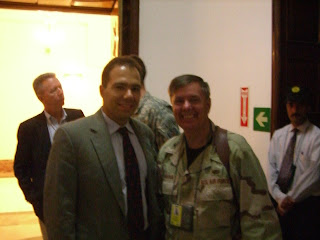
Wednesday night I had the privilege of being invited to the farewell dinner that Gen. Petraeus hosted for Sen. Lindsey Graham (R-SC), who had been visiting the previous week or so. Also attending were the US Ambassador, Ryan Crocker; the Deputy CG, British Lt. Gen. Bill Rollo; my boss, the Staff Judge Advocate, Col. Mark Martins; the Embassy's Rule of Law Coordinator Jim Santelle; and other assorted high-ranking military and civilian personnel.


It was the sort of occasion you for would do anything to be a fly on the wall. And there I was, between a three-star general and a navy captain, a human-sized fly on the wall.

The dinner started auspiciously, as the guests filed into the room and waiters appeared with our "cocktails" (soft drinks). I had a fascinating conversation with Lt. Gen. Rollo -- whom I had met a few weeks earlier during my tour of the Rusafa ROLC -- and concluded that the British forces are in fine hands indeed.


After being seated, Gen. Petraeus welcomed us and Sen. Graham made brief remarks about how quickly the time had gone, etc. We were served a very nice cucumber and tomato salad, followed by stuffed lobster with wax beans and potatoes -- sounds ostentatious, but KBR gets a discount on lobster; I've eaten it far more often here than anywhere short of Maine or the Canadian Maritimes -- and finally vanilla ice cream with fruit. It was a simple meal, and good.


Then, in the absence of brandy snifters (and brandy), Sen. Graham held forth on a number of subjects, which I obviously can't go into here. Amb. Crocker, whom I hadn't heard speak much before, also contributed mightily to the discussion. Gen. Petraeus presented Sen. Graham with a memento of his visit, and then also awarded Charlie Abner, the LAOTF Chief of Staff, with a medal honoring his tireless civilian service in Iraq.


Following the dinner, Gen. Petraeus asked me how I had enjoyed my time here and whether they could convince me to come back. It's been fascinating, I said, and I'd be happy to be back if the appropriate arrangements can be made. (Because of my lack of citizenship, I can't be paid by the government nor receive any sort of security clearance -- both of which inhibit the viability of my future service here.)


Then I went off to change from my suit into my uniform, as we were taking a helicopter out to Camp Victory to do some touring the next day (yesterday).