Every Sunday night at 2000, the good folks at MWR screen a movie outdoors by the pool -- at the same venue where they have weekly karaoke, beside the ping-pong tables. Tonight's feature was Anchorman.
While not a huge WIll Ferrell fan -- I think Old School to be unworthy of the Animal House genre, and Ferrell's George Bush on SNL mainly left one pining for Chevy Chase -- I really enjoyed Anchorman the one time I saw it. I would've watched tonight, but sitting in long pants (I was coming from work and then dinner) in 100+ degree heat is just not my cup of tea, even without the blazing sun.
Showing posts with label embassy. Show all posts
Showing posts with label embassy. Show all posts
Sunday, August 26, 2007


Friday, August 24, 2007
I Was the Fly on the Wall
Wednesday night I had the privilege of being invited to the farewell dinner that Gen. Petraeus hosted for Sen. Lindsey Graham (R-SC), who had been visiting the previous week or so. Also attending were the US Ambassador, Ryan Crocker; the Deputy CG, British Lt. Gen. Bill Rollo; my boss, the Staff Judge Advocate, Col. Mark Martins; the Embassy's Rule of Law Coordinator Jim Santelle; and other assorted high-ranking military and civilian personnel.
It was the sort of occasion you for would do anything to be a fly on the wall. And there I was, between a three-star general and a navy captain, a human-sized fly on the wall.
The dinner started auspiciously, as the guests filed into the room and waiters appeared with our "cocktails" (soft drinks). I had a fascinating conversation with Lt. Gen. Rollo -- whom I had met a few weeks earlier during my tour of the Rusafa ROLC -- and concluded that the British forces are in fine hands indeed.
After being seated, Gen. Petraeus welcomed us and Sen. Graham made brief remarks about how quickly the time had gone, etc. We were served a very nice cucumber and tomato salad, followed by stuffed lobster with wax beans and potatoes -- sounds ostentatious, but KBR gets a discount on lobster; I've eaten it far more often here than anywhere short of Maine or the Canadian Maritimes -- and finally vanilla ice cream with fruit. It was a simple meal, and good.
Then, in the absence of brandy snifters (and brandy), Sen. Graham held forth on a number of subjects, which I obviously can't go into here. Amb. Crocker, whom I hadn't heard speak much before, also contributed mightily to the discussion. Gen. Petraeus presented Sen. Graham with a memento of his visit, and then also awarded Charlie Abner, the LAOTF Chief of Staff, with a medal honoring his tireless civilian service in Iraq.
Following the dinner, Gen. Petraeus asked me how I had enjoyed my time here and whether they could convince me to come back. It's been fascinating, I said, and I'd be happy to be back if the appropriate arrangements can be made. (Because of my lack of citizenship, I can't be paid by the government nor receive any sort of security clearance -- both of which inhibit the viability of my future service here.)
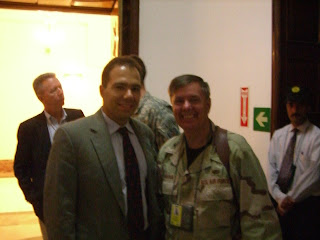 Then I went off to change from my suit into my uniform, as we were taking a helicopter out to Camp Victory to do some touring the next day (yesterday).
It was the sort of occasion you for would do anything to be a fly on the wall. And there I was, between a three-star general and a navy captain, a human-sized fly on the wall.
The dinner started auspiciously, as the guests filed into the room and waiters appeared with our "cocktails" (soft drinks). I had a fascinating conversation with Lt. Gen. Rollo -- whom I had met a few weeks earlier during my tour of the Rusafa ROLC -- and concluded that the British forces are in fine hands indeed.
After being seated, Gen. Petraeus welcomed us and Sen. Graham made brief remarks about how quickly the time had gone, etc. We were served a very nice cucumber and tomato salad, followed by stuffed lobster with wax beans and potatoes -- sounds ostentatious, but KBR gets a discount on lobster; I've eaten it far more often here than anywhere short of Maine or the Canadian Maritimes -- and finally vanilla ice cream with fruit. It was a simple meal, and good.
Then, in the absence of brandy snifters (and brandy), Sen. Graham held forth on a number of subjects, which I obviously can't go into here. Amb. Crocker, whom I hadn't heard speak much before, also contributed mightily to the discussion. Gen. Petraeus presented Sen. Graham with a memento of his visit, and then also awarded Charlie Abner, the LAOTF Chief of Staff, with a medal honoring his tireless civilian service in Iraq.
Following the dinner, Gen. Petraeus asked me how I had enjoyed my time here and whether they could convince me to come back. It's been fascinating, I said, and I'd be happy to be back if the appropriate arrangements can be made. (Because of my lack of citizenship, I can't be paid by the government nor receive any sort of security clearance -- both of which inhibit the viability of my future service here.)
Then I went off to change from my suit into my uniform, as we were taking a helicopter out to Camp Victory to do some touring the next day (yesterday).
Wednesday, August 22, 2007
Just Play Me That Ol' Time Country Music
Last night when I went back to my office after dinner, I noticed that the tall doors leading to the south ballroom where my office is located were closed. (They're never closed.) Then I noticed a weird sound coming from down a hallway not too far away, across from the copy center and beside the clinic. It was... banjo music!
It turns out that periodically an army duo sets up their musical gear in this nook and plays bluegrass in front of an audience that ranges from 0 to a baker's dozen. I didn't stay for long, but it certainly made me chuckle.
So the closed doors were to stop the music from entering our vault of labors. I guess not everyone's partial to the sounds of a harmonica echoing off marble...
Monday, August 20, 2007
Running with the Colonel Redux
This morning at 0530, for the third time now, I did the standard 3-mile loop around the IZ with my boss in the 90-degree pre-dawn heat. For the second time, I completed it without hitting a wall. For the first, I kept up my side of the conversation up to the very end. Now, I can't vouch that the pace of each of the three runs was the same -- though I think it was based on rough glances at my watch -- but I think we're making progress.
Which is good because, apparently, exercise makes you smarter.
Which is good because, apparently, exercise makes you smarter.
Saturday, August 18, 2007
Wearing Sweaters in an Oven
In true American fashion, the air conditioning system at the embassy is blasted so high that, even though it's typically 120 degrees outside, it's positively cold inside. Especially the Green Bean coffee shop/lounge area: I just can't spend any time there unless I'm wearing a long-sleeve shirt and/or two layers.
This micro-climate is enhanced on Fridays and Saturdays, the "weekend" days when many civilian embassy employees don't work (or work less time), leaving fewer warm bodies to counteract the effect of the AC. Yesterday at one point I had to step outside and read some briefs in a shaded area by the pool just to warm up a bit.
It's faintly ridiculous, but I suppose provides incentive for me to either wear a suit or my ACU (All-purpose Combat Uniform) rather than the typical civilian "uniform" of khakis and a polo shirt.
Hockey Night in Baghdad
The other day I joked with my boss that what the embassy complex was lacking was an ice rink. "Gotta get my hockey fix," I said.
He reminded me about the 4-on-4 street hockey that took place by the gym. And, indeed, street hockey was one of the sports activities organized by the MWR folks. Every other Friday evening at dusk, the hoopsters are ushered off the court, to be replaced by a bunch of rangy guys with plastic sticks and a rubber ball.
I had so much fun playing last night, and didn't realize when it was all over that I had had almost an hour and a half of exercise that was a heckuva lot more than going running (with or without my boss). Most of the guys were enlisted soldiers, with a few civilians thrown in. As the night went on, we felt a growing camraderie, and it's unfortunate that by the time the next hockey night rolls around, I'll be on a plane going home.
Meeting of the Mind-Sets
Former Pentagon historian John M. Rosenberg had a piece in the Stars & Stripes on Thursday about the different mentalities that State Department officials and military folks bring to the table here at the Embassy. More specifically, he details the rather obvious clash of cultures and attitudes. (Sample: "the preppy young functionaries of State occasionally murmur their displeasure over having to occupy the same space with what they consider as the boorish, tobacco-dipping soldiers; while the young enlisted are prone to deride the soft, whiney civilians.")
It's a fascinating issue, and the crucible-forged accentuation of inter-agency conflicts typical to any complex government operation. I will no doubt have my own thoughts to share once I return Stateside and can begin to process some of these larger-picture themes of my time here.
It's a fascinating issue, and the crucible-forged accentuation of inter-agency conflicts typical to any complex government operation. I will no doubt have my own thoughts to share once I return Stateside and can begin to process some of these larger-picture themes of my time here.
Friday, August 17, 2007
Regrets I've Had a Few
I've gotten a bit of flak for my Daily Standard piece, specifically for making it seem that the MNFI (or all Embassy) leaders are living a life of detached luxury while personnel are suffering, sacrificing, and dying in the field.
Nothing could be further from the truth, of course, and I apologize for any such implication. I just meant to convey the surrealism of life in the IZ -- with people dying out there and helicopters flying at all hours while we go back and forth between trailer and office.
People work long hours here: 12-16 hours/day is the norm, on both the military and civilian side. And everyone appreciates the sacrifices of the men in the field, and their families.
I thus apologize for any "friendly fire" my piece may have caused.
The Lock & Load
Another bar available to those not constrained by General Order #1 (those serving in the military may not drink alcohol) is the "Lock & Load," a drinking establishment operated by/benefiting the RSO -- the embassy's security office. Apparently they'd previously been busted for unspecified offenses and are now open by invitiation only, and cannot charge for drinks (just "donations"). According to the patrons of the "Off-Site," the Lock & Load is the "working class bar."
Weel call me Joe and get me a six-pack, 'cause I always have a great time at the L&L. It was only my second time there, but they treat me right... Tonight I met a recovering Mormon from Utah who voted (twice) for Ralph Nader. (Apparently has a tshirt that says "Bush and Kerry make me Ralph.") And now he's working on the mission here in Baghdad. What a country!
I also bumped into a girl who shared my CRC experience back at Fort Benning. Good times.
Daily Standard Piece: Club Med Baghdad
The Weekly Standard's online publication, The Daily Standard, just ran a piece collecting my initital observations of life here behind the wire. It's about two weeks dated because they held it for a Friday run so it would stay on top of the webpage through the weekend.
Monday, August 13, 2007
My Hooch
Each picture I put up is worth roughly 1000 words, they tell me, so instead of describing where I live, here's the photographic evidence. (Note that I can't show anything of the outside of the trailer other than the front door because that would give away how our security works.)


Saturday, August 11, 2007
Nice Job If You Can Get It
A few days ago I attended one of the periodic welcome briefings for all new non-military embassy personnel. The vast majority are State Department folks, but there are some from other agencies, as well as contractors and the like. We got briefings on security, HR, medical issues, mental health ("come to us before you go crazy here"), IT, Finance, Consular Services, and a few others -- such as the contractor Kellogg, Brown and Root (KBR), which runs everything from the dining hall to laundry, office supplies, and MWR.
The briefing was led off with a welcome from the Deputy Chief of Mission, the "vice-ambassador," Patricia Butenis (whose signature got me my badge) and was organized by a familiar face. It turns out that the "front office" executive secretary is a guy who was the graduate assistant to my policy task force my junior year of college -- and was one of our "chaperones" for various official meetings in Brussels for spring break 1998 ("Eurocrats Gone Wild"). He went into the foreign service after his MPA and here he is. Small world.
Much of the briefing was either inapplicable to me or I'd already picked it up in my short time here. (Believe it or not, given the turnover, I'm already "established.") One of the more interesting inapplicable tidbits to pick, however, was the compensation package folks staffed here receive.
There's a 35% hazard pay bonus, followed by a 35% "location" bonus, plus per diems and overtime pay, plus several two-week paid vacations and 5-day local R&Rs (taken in Qatar or Rome, I believe). It's pretty sweet, and seems to be a lot better than what the military guys get.
Thursday, August 9, 2007
Stovepipes of Excellence
In reading background materials and attending various meetings relating to rule of law programming, one issue struck me as needlessly complicating an already complex mission with many moving parts: For many reasons, many of them quite benign, less-than-ideal inter-agency collaboration acts as a barrier to forward movement.
Even as people work hard and well within their own bailiwicks, there can be a lack of awareness about what others are doing, which can lead to both duplication of effort and gaps in coverage. This is true as between cabinet-level agencies (State, DOJ, DoD), and within them. I've often heard this phenomenon described as "stovepipes of excellence."
To be clear, this goes beyond the usual/expected fights over turf and conflicts in allegiance, and even personality conflicts and different agency cultures. These still exist, of course, but the real issue is, as the (relatively) newly established Rule of Law Coordinator puts it, herding cats. And making sure that what all these cats are doing -- productive as it is in a vacuum -- gets disseminated amongst themselves and to the Big Cat (here that means, ultimately, the Ambassador).
This is an area I hope to delve into a bit in my remaining time here (because, you know, it's so readily solvable). I just spoke with a professor of public management, actually, whom I had done research for one summer in college. He gave me some pointers and further direction. A few initial suggestions:
- Mandate/support from the top.
- Cooperation/information-sharing along people at lower levels.
- Building common databases.
- Common/pooled funding sources.
- Measurables/benchmarks requiring inter-agency contributions.
Makes sense. The proof, as always, is in the public policy implementation. (That was actually the name of a class John DiIulio used to teach when he was at Princeton's Woodrow Wilson School, "Public Policy Implementation.")
Monday, August 6, 2007
Running with the Colonel
This morning I awoke at 0515 to meet my boss for a nice little run before it got too hot outside. Of course it was already 85-90 degrees, with the air as heavy as it always is here, but never mind.
We exited the embassy compound proper and began running along the concrete barricades in the pre-dawn light. The talk turned to swimming and tennis, as the Colonel tried to feel out my athletic background, to see how much he could really push me on this 3-miler. (He had completed four marathons in his day, with a best time of 2:44 no less -- and I had been warned not to let him bet me money on a footrace.)
Then, naturally, we broached Cobra II -- which I posted about earlier this week -- and the latest book I've been reading, Niall Ferguson's Colossus. By the time we finished all that, dawn had broken in its full splendor, so we could see all the stray dogs and hand-painted "Villa for Rent" signs on the side of the road. (A villa in the IZ... yeah, "snookums how about we start summering on the Tigris; it's the Marbella of the Middle East, you know... " -- not so much.)
Toward the end of our run, long after we passed the "Victory Over Iran" monument, my energy began to flag. Not so much my energy as, seemingly, my lung capacity. My legs still felt fresh -- was ready for the finishing kick -- but the ol' respiratory system was feeling it. And of course the Colonel was psyching me out with all his, "just past the arch," "just around the corner," "only about 200m after the light."
So I shut it down early and made it to the gym about half an hour after we set out, just in time to put in some push-ups, shoulder presses, and bicep curls before hitting the showers, breakfast, and continuing to do more before 9am than most people do in a day.
Sunday, August 5, 2007
Steak & Lobster Night
Today it was steak and lobster night at our dining hall. Nobody announced it, there was no anticipatory murmuring among the hoi polloi, and even when we learned of it people weren't particularly more excited than they normally are at dinner time. This isn't because soldiers and diplomats are snobbish or expect to be served steak and lobster, but because the food here is pretty darn good. (The lobster was a bit dry tonight, but hey, I'm sure that Maine-to-Mesopotamia flight can be rough.)
And I must say generally that military food -- at least that which I've been exposed to at Fort Benning, Camp Sather (the Air Force base by Baghdad Airport) and here -- has been a very pleasant surprise. There's a huge variety of entrees, sides, salad and sandwich items, drinks, and desserts. You can eat as healthy as you want and as much as you want, and everything is always fresh and clean.
The DFAC (Dining Facility something something, aka "mess" "chow hall") here is enormous, and here's how the process works: First you walk across the pathway from the embassy and clear your weapon (if you're carrying one) into a sand-filled barrel. After the Peruvian guard [more on the Latin American contractors working checkpoints in future] checks that you have the proper badge -- I'm telling you, badges are everything here -- you step into air conditioned splendor, wash your hands, and go down one of two "main lines." There, for every meal, you have a choice of three entrees and commensurate sides and fixin's. If the main line isn't doin' it for ya, you can check out the "theme bar" (I've seen Arabic, Chinese, Indian, Louisiana, pasta, potato, and pizza, among others) and get scrumptious chow there. Then you proceed to the salad bar (or you can pick up a slice of cake or pie first) and load up on whatever you want (including at least two types of lettuce, bok choy, and jalapenos). If you still need more food, you can make a detour to the grill -- which offers different items each meal (omelettes for breakfast, sausage 'n' peppers, roast beef, gyro, carved ham, Mongolian stir fry, fajitas, etc.) -- or to the soup station, which features two soups daily. Finally it's time to pick up drinks, which range from various kind of milk and juice boxes (my favorites are the cocktail of nectars and the pink grapefruit) to iced tea (sweet or regular), sodas, several kinds of Gatorade, and, of course, bottled water. Then you go to your seat and chow down.
Unless you want something from the short order grill on the other side of the hall, with the TVs showing sports 24 hours/day. There you can get burgers, dogs, fried fish, chili, grilled cheese or turkey sandwiches, fries, and onion rings. Once a week it's its own separate pasta bar.
After dinner, if you want to make what my JAG buddies call the "walk of shame", dessert ranges from fresh-baked cookies to soft-serve frozen yogurt, Belgian waffles to 10 or 12 kinds of ice cream. Plus the aforementioned cakes, pies, and other baked goodies. And of course many kinds of fresh fruit, including my favorite: kiwi (from New Zealand no less).
Before you go, or before they roll you out of there, be sure to pick up a PowerBar and Gatorade to keep in your hooch. Because you may have to wait as long as three hours before the DFAC opens again for the next meal...
My New Roomie
When I got "home" (back to my trailer) today to change and "PT" (work out), I noticed that the other "rack" (bed), heretofore empty and unoccupied, was all of a sudden made and had a pair of combat boots beside it. So, after two weeks of having a private "hooch" (in-theater residence, a term picked up from the Vietnamese 40 years ago), I now have a roommate.
Haven't met him yet, though I deduced by the cap he left on the closet that he was an O-4 in either the Navy or Air Force (their desert uniforms are identical other than the AF's having a special patch on the left upper arm). That is, my roomie was either an Air Force Major or a Navy Lieutenant Commander. Which means two things: 1) If he's active duty, he's about my age or a bit older; and 2) like all USN and USAF personnel here he's in some non-combat specialty (logistics, intelligence, medicine, JAG).
I guess I'll find out later tonight.
Saturday, August 4, 2007
Wetting a Very Parched Whistle
Last night I finally found the lone "official" location for getting alcohol in the embassy compound, a space that can only in the loosest sense be called a bar. It's called "The Off-Site" because it's across the street from the embassy proper, in an industrial area on the ground floor of a building that used to be associated with the UN Oil-for-Food program. And it's only open Friday nights for a few hours. Good enough for my first drink in three weeks.
The best (and pretty much only) thing about the place is that the drinks are cheap and the portions -- because the bartenders are volunteering amateurs -- generous. Other than that, it's a like a reception area for a small office decorated with Christmas lights. Two lonely stools stand by the "bar" and white plastic lawn furniture that has seen better days fills out the rest of the place.
The closest thing to which I can compare it from my experience is a college dorm party in England -- an American ex-pat feel with lots of kids "studying abroad." I spent most of the night talking to an Australian ex-special forces ex-intelligence guy now working as a strategic planning contractor. We discussed rugby, using tribes (and tribal intelligence) to defeat the insurgency, and (after a few more $3 Johnnie Walker Red doubles) the meaning of life. "Power and influence is ultimately rubbish," he opined. "Love a woman and raise a kid well -- that's how you lead a good life."
I also met a U.S. contractor -- some sort of financial/computer guru -- who's helping automate the Iraqi stock market. And this guy wasn't a wet-behind-the-ears Silicon Valley whizkid, but rather someone who's been programming highly sensitive computers since the 60s. Told me there was a lot of money wasted on his project in the early days but now things are on track, except for security concerns imposing all sorts of delays.
My final interlocutor was a State Department Arabist who had a slightly different point of view from the Aussie. According to this person, it's all about the people we throw our lot in to run the government and its ministries -- and their connections to Iran and various militias.
Fascinating stuff, and again a surreal environment. Next week I'll have to bring my camera and take some pics. (Speaking of pictures, the reason I haven't been posting any is because we need to get permission to be able to take any whatsoever -- even, e.g., the pool or the ballroom decorations -- I'm working on it.)
Friday, August 3, 2007
Of Fruity Drinks and Car Bombs
I just spent an enjoyable couple of hours with my friend Mario Loyola, who works for the Foundation for the Defense of Democracies and is at the start of a six-week stint in Iraq, writing primarily for National Review. You can read Mario's last two dispatches on NRO here and here.
Mario's trip got off to an unfortunate start, Qatar Airlines having lost his bags on the way in from Washington. To add insult to injury, the PX by the Embassy does not stock boots or field-suitable pants, so he's essentially left with the clothes on his back and whatever stuff he had in his backpack (most of which was taken up with his body armor).
Now, because my badge doesn't permit me to escort anyone around the Embassy complex, I had to enlist the services of one of the JAGs who works on rule of law issues so we could show Mario around the place. As anyone would, he marveled at the marble floors and ornate ceiling decorations in the Embassy. "You mean we took over the Presidential Palace unscathed and made it our Embassy?" Mario questioned incredulously. (And indeed it is surprising that this complex remained intact throughout the battle for Baghdad.)
Then we took him out to the pool area, which he compared to a resort in his native Puerto Rico. Other than the paucity of women in g-string bikinis, it really could have been: "All we're missing is fruity umbrella drinks," Mario said with a smile. We had to make do with multiple water bottles -- without little umbrellas -- in the lounge area, while talking Iraqi and U.S. politics. Such is life in Club Med Baghdad.
Tuesday, July 31, 2007
What It Takes to Run an Embassy in a War Zone
Not that you asked, but here are all the agencies/sections/offices (not including DoD/MNF-I) housed in the US Embassy-Baghdad, which is currently the largest American embassy in the world. All of my non-DoD work concerns agencies/officials under the Office of the Rule of Law Coordinator.
Consular Affairs
Coordinator for Economic Transition in Iraq
Economic Affairs
Energy Attaché
Foreign Agriculture Service
Foreign Commercial Service
Health Attaché
ITAO
Transportation Attaché
Treasury Attaché
U.S. Agency for International Development
WMD Redirect Program
Executive Office
Secretariat
Legislative Affairs
Protocol
Language Services
Joint Strategic Planning & Assessment (JSPA)
Legal Adviser
Management
Cashier
Facilities Maintenance
Financial Management
General Services Office
GSO – Sully Compound
Health Unit
Human Resources
Information Resource Management
KBR
NEC Transition Team
Political
Legal Framework and Legislation
Political-Military
Hostage Affairs
Office of Provincial Affairs
PRTs – one entry addressing all of our PRTs
ePRTs – one entry addressing all of our ePRTs
REO Basra
REO Hillah
Public Affairs
Press Office
Cultural Affairs Office
Regional Security Office
Counter Measures
High Threat
Investigations
Logistics
Embassy Transition Team
Tactical Operations Center
MSG Detachment
Engineering Security Office
Office of the Rule of Law Coordinator
Office of Accountability and Transparency
Bureau of Alcohol, Tobacco, Firearms and Explosives
Drug Enforcement Administration
Homeland Security Attaché
International Criminal Investigative Training and Assistance Program (ICITAP)
International Narcotics & Law Enforcement
Justice Attaché
Legal Attaché/FBI
Major Crimes Task Force
OPDAT
Regime Crimes Liaison Office
Office of the Senior Advisor to the Ministry of Justice
Office of the Senior Advisor to the Ministry of Interior
U.S. Marshals Service
Special Inspector General for Iraq Reconstruction (SIGIR)
USAID Regional Inspector General
Monday, July 30, 2007
Morale, Welfare, Readiness
War is hell. Not that I would know personally -- other than random rockets and stray celebratory fire, I haven't really been in harm's way (knock on wood) -- but I can certainly imagine. To maintain morale, the military (here in conjunction with the State Department) contracts for a variety of MWR (Morale, Welfare, Readiness) facilities an programming. On the embassy compound, that means everything from yoga and dominoes, a movie theater and 24-hour gym.
This morning I received in my email inbox -- yes, by the way, I'm now the proud owner of both DoD and State email accounts -- a schedule of MWR activities for the week. Activities are centered around three areas: the pool, the gym, and the 24-hour coffeeshop/lounge in the middle of the palace. Along with swim meets and regattas (with man-size boats made of empty water bottles) in the actual pool, the space around it hosts a variety of weekly theme nights, such as karaoke Wednesdays, country Thursdays, and salsa Fridays. The area by the gym features soccer, basketball, and street hockey. And the central lounge (named "Green Bean" after the coffee chain that I'm supposed to have heard of") plays host to domino tournaments, chess matches, jujitsu, and a bunch of other things.
Some of it is a bit cheesy -- especially the full-color photo-shopped ads they use to advertise everything -- but it does lighten the mood and provide necessary stress relief.
Come to think of it, it's all part of the great Club Med Baghdad.
Subscribe to:
Posts (Atom)

 Posts

