This morning at 0530, for the third time now, I did the standard 3-mile loop around the IZ with my boss in the 90-degree pre-dawn heat. For the second time, I completed it without hitting a wall. For the first, I kept up my side of the conversation up to the very end. Now, I can't vouch that the pace of each of the three runs was the same -- though I think it was based on rough glances at my watch -- but I think we're making progress.
Which is good because, apparently, exercise makes you smarter.
Monday, August 20, 2007


Sunday, August 19, 2007
Iraq, Inc.
It took me but a few hours to polish off a book that had much promise and was filled with dense, heavily reported detail, but was ultimately unsatisfying. Iraq, Inc., by Pratap Chatterjee of the anti-business watchdog group CorpWatch, purports to tell the tale of how nobody gained from the Iraq "occupation" except military contractors like Halliburton and Bechtel. (And how, surprise surprise, Dick Cheney ultimately profited/masterminded it all.)
It begins with a bizarre morality tale about Iraqi (or is it Indian/Pakistani) workers' lack of union rights -- so why were these people clamoring for the jobs again? -- and ends up in a dry litany of cost-overruns and inefficiencies.
OK, we get it: Halliburton, etc., engaged in some shady accounting practices. DoD turned a blind eye through a combination of incompetence and cronyism. And after it was all over (or as of the writing of the book), Iraq was still not rebuilt.
Problem is, all the bad stuff this conspiracy theorizing reveals -- and, to be sure, there was some unlawful accounting, as well as harm done by letting the perfect get in the way of the good -- pales in comparison to the policy mistakes detailed in the likes of Cobra II. If Paul Bremer hadn't disbanded the Iraqi army or disqualified all former Baathists from office, for example, would we really be complaining that Halliburton's subsidiary KBR (which still runs the DFACs here) double-billed for meals a couple of times? Or that it serves pork, which is, of course, offensive to Muslim sensibilities? (Actually, the latter I'm not sure we should care about even now.)
No, the book had promise, and some of its charges are perfectly valid, but its shrillness and obvious bias detracts from the point it's trying to make.
It begins with a bizarre morality tale about Iraqi (or is it Indian/Pakistani) workers' lack of union rights -- so why were these people clamoring for the jobs again? -- and ends up in a dry litany of cost-overruns and inefficiencies.
OK, we get it: Halliburton, etc., engaged in some shady accounting practices. DoD turned a blind eye through a combination of incompetence and cronyism. And after it was all over (or as of the writing of the book), Iraq was still not rebuilt.
Problem is, all the bad stuff this conspiracy theorizing reveals -- and, to be sure, there was some unlawful accounting, as well as harm done by letting the perfect get in the way of the good -- pales in comparison to the policy mistakes detailed in the likes of Cobra II. If Paul Bremer hadn't disbanded the Iraqi army or disqualified all former Baathists from office, for example, would we really be complaining that Halliburton's subsidiary KBR (which still runs the DFACs here) double-billed for meals a couple of times? Or that it serves pork, which is, of course, offensive to Muslim sensibilities? (Actually, the latter I'm not sure we should care about even now.)
No, the book had promise, and some of its charges are perfectly valid, but its shrillness and obvious bias detracts from the point it's trying to make.
Saturday, August 18, 2007
Ali Baba and the 40 Insurgents
Interesting tidbit: When US forces ask locals for the whereabouts of insurgents, they inquire about Ali Baba.
Wearing Sweaters in an Oven
In true American fashion, the air conditioning system at the embassy is blasted so high that, even though it's typically 120 degrees outside, it's positively cold inside. Especially the Green Bean coffee shop/lounge area: I just can't spend any time there unless I'm wearing a long-sleeve shirt and/or two layers.
This micro-climate is enhanced on Fridays and Saturdays, the "weekend" days when many civilian embassy employees don't work (or work less time), leaving fewer warm bodies to counteract the effect of the AC. Yesterday at one point I had to step outside and read some briefs in a shaded area by the pool just to warm up a bit.
It's faintly ridiculous, but I suppose provides incentive for me to either wear a suit or my ACU (All-purpose Combat Uniform) rather than the typical civilian "uniform" of khakis and a polo shirt.
This micro-climate is enhanced on Fridays and Saturdays, the "weekend" days when many civilian embassy employees don't work (or work less time), leaving fewer warm bodies to counteract the effect of the AC. Yesterday at one point I had to step outside and read some briefs in a shaded area by the pool just to warm up a bit.
It's faintly ridiculous, but I suppose provides incentive for me to either wear a suit or my ACU (All-purpose Combat Uniform) rather than the typical civilian "uniform" of khakis and a polo shirt.
Hockey Night in Baghdad
The other day I joked with my boss that what the embassy complex was lacking was an ice rink. "Gotta get my hockey fix," I said.
He reminded me about the 4-on-4 street hockey that took place by the gym. And, indeed, street hockey was one of the sports activities organized by the MWR folks. Every other Friday evening at dusk, the hoopsters are ushered off the court, to be replaced by a bunch of rangy guys with plastic sticks and a rubber ball.
I had so much fun playing last night, and didn't realize when it was all over that I had had almost an hour and a half of exercise that was a heckuva lot more than going running (with or without my boss). Most of the guys were enlisted soldiers, with a few civilians thrown in. As the night went on, we felt a growing camraderie, and it's unfortunate that by the time the next hockey night rolls around, I'll be on a plane going home.
He reminded me about the 4-on-4 street hockey that took place by the gym. And, indeed, street hockey was one of the sports activities organized by the MWR folks. Every other Friday evening at dusk, the hoopsters are ushered off the court, to be replaced by a bunch of rangy guys with plastic sticks and a rubber ball.
I had so much fun playing last night, and didn't realize when it was all over that I had had almost an hour and a half of exercise that was a heckuva lot more than going running (with or without my boss). Most of the guys were enlisted soldiers, with a few civilians thrown in. As the night went on, we felt a growing camraderie, and it's unfortunate that by the time the next hockey night rolls around, I'll be on a plane going home.
Meeting of the Mind-Sets
Former Pentagon historian John M. Rosenberg had a piece in the Stars & Stripes on Thursday about the different mentalities that State Department officials and military folks bring to the table here at the Embassy. More specifically, he details the rather obvious clash of cultures and attitudes. (Sample: "the preppy young functionaries of State occasionally murmur their displeasure over having to occupy the same space with what they consider as the boorish, tobacco-dipping soldiers; while the young enlisted are prone to deride the soft, whiney civilians.")
It's a fascinating issue, and the crucible-forged accentuation of inter-agency conflicts typical to any complex government operation. I will no doubt have my own thoughts to share once I return Stateside and can begin to process some of these larger-picture themes of my time here.
It's a fascinating issue, and the crucible-forged accentuation of inter-agency conflicts typical to any complex government operation. I will no doubt have my own thoughts to share once I return Stateside and can begin to process some of these larger-picture themes of my time here.
Friday, August 17, 2007
Regrets I've Had a Few
I've gotten a bit of flak for my Daily Standard piece, specifically for making it seem that the MNFI (or all Embassy) leaders are living a life of detached luxury while personnel are suffering, sacrificing, and dying in the field.
Nothing could be further from the truth, of course, and I apologize for any such implication. I just meant to convey the surrealism of life in the IZ -- with people dying out there and helicopters flying at all hours while we go back and forth between trailer and office.
People work long hours here: 12-16 hours/day is the norm, on both the military and civilian side. And everyone appreciates the sacrifices of the men in the field, and their families.
I thus apologize for any "friendly fire" my piece may have caused.
Nothing could be further from the truth, of course, and I apologize for any such implication. I just meant to convey the surrealism of life in the IZ -- with people dying out there and helicopters flying at all hours while we go back and forth between trailer and office.
People work long hours here: 12-16 hours/day is the norm, on both the military and civilian side. And everyone appreciates the sacrifices of the men in the field, and their families.
I thus apologize for any "friendly fire" my piece may have caused.
The Lock & Load
Another bar available to those not constrained by General Order #1 (those serving in the military may not drink alcohol) is the "Lock & Load," a drinking establishment operated by/benefiting the RSO -- the embassy's security office. Apparently they'd previously been busted for unspecified offenses and are now open by invitiation only, and cannot charge for drinks (just "donations"). According to the patrons of the "Off-Site," the Lock & Load is the "working class bar."
Weel call me Joe and get me a six-pack, 'cause I always have a great time at the L&L. It was only my second time there, but they treat me right... Tonight I met a recovering Mormon from Utah who voted (twice) for Ralph Nader. (Apparently has a tshirt that says "Bush and Kerry make me Ralph.") And now he's working on the mission here in Baghdad. What a country!
I also bumped into a girl who shared my CRC experience back at Fort Benning. Good times.
Weel call me Joe and get me a six-pack, 'cause I always have a great time at the L&L. It was only my second time there, but they treat me right... Tonight I met a recovering Mormon from Utah who voted (twice) for Ralph Nader. (Apparently has a tshirt that says "Bush and Kerry make me Ralph.") And now he's working on the mission here in Baghdad. What a country!
I also bumped into a girl who shared my CRC experience back at Fort Benning. Good times.
Daily Standard Piece: Club Med Baghdad
The Weekly Standard's online publication, The Daily Standard, just ran a piece collecting my initital observations of life here behind the wire. It's about two weeks dated because they held it for a Friday run so it would stay on top of the webpage through the weekend.
Thursday, August 16, 2007
Iran & Al Qaeda
That's who takes over if we leave, the former on the Shia side, the latter on the Sunni. Forgetting all that's gone on before, that's why this mission is important going forward.
The Iraqi Government
Here is a list of the Iraqi President, two Vice-Presidents, Prime Minister, two Deputy Prime Ministers, and Cabinet, as well as the Governor of the Central Bank and Ambassadors to the US and UN. It is current as of May 17 -- so does not reflect the walkout of the Sunni bloc (which resignations were never formally accepted anyway) or other developments of the last three months. Note that there are 26 Ministers, plus 11 "Ministers of State" (akin to Britain's junior ministers).
Iraqi Civil Courts
I should mention that, by all accounts, the country's civil (as opposed to criminal) courts are up and running fine -- and Iraqis are comfortable going to lawyers and filing claims for, e.g., contract claims, disputes with neighbors, divorces, etc. In the cities more so than in the country, of course, with tribal councils and unofficial sharia courts being more prevalent outside major centers.
Of course, I'm sure there are fewer inter-sectarian suits -- wrongful death claims and the like -- or at least less enforcement of resulting judgments. But in terms of a small business suing its supplier for providing shoddy product, for example, that seems to be covered.
Of course, I'm sure there are fewer inter-sectarian suits -- wrongful death claims and the like -- or at least less enforcement of resulting judgments. But in terms of a small business suing its supplier for providing shoddy product, for example, that seems to be covered.
Wednesday, August 15, 2007
A Meeting with the Minister (Justice)
I already blogged about my meeting with the Minister of Justice. We discussed detention facilities, the need to process detainees faster, keep better arrest records, etc. Unfortunately, the Minister went on vacation for most of August, but things seem to be progressing without him. Just yesterday, the Iraqis released over 80 detainees from Khadamiya, one of the overcrowded prisons that had become a political embarassment to the governent. So things are moving, if slowly...


Below are some pictures from outside the Minister's office, in front of the Monument to the Unknown Soldier. There used to be one where I appear beside an Iraqi Army colonel -- just promoted to brigadier general -- who has done a workmanlike job in investigating atrocities by Iraqi police. I took it down for security reasons.
America's Empire Deficit
I finally finished Colossus, and highly recommend it. Niall Ferguson is both provocative and well-researched, timely and fundamental. The point is that when America gets involved in overseas adventures -- for whatever reason, from the most realist to the most humanitarian -- it inevitably acts like an empire. The sooner it admits this and takes on the role unapologetically, the greater its success can be.
The question, then, is how to organize the "nation-building" -- or, to avoid using the somewhat loaded word "nation," the reconstruction/development work. One view argues for expanding the military, developing more "civilian affairs" capacity. After all, we already have engineers of all sorts, lawyers, doctors, and all sorts of other professionals in the military. Building that capacity would take advantage of the military's existing command and control structure, and recognize that in this brave new world the army exists to run a place, not just make war.
I think that's a stop-gap, and an answer that perhaps works in Iraq's unique environment at this point in time (during a counterinsurgency when we don't have a large enough civilian capacity), but is not the correct structural solution. In fact, this is an easier call than the decision about the circumstances under which we should nation-build or whether to be in the business at all.
The British India Civil Service (ICS) is a good model for what we need, I think -- a civilian body ready to be mobilized as needed, a Peace Corps with teeth that would work in conjunction with the military. More on such a Civilian Response Readiness Corps (as was proposed in legislation sponsored last term) in future as I develop my thinking in consultation with the folks around me.
But one final point: Ferguson diagnoses three deficits "that together explain why the United States has been a less effective empire than its British predecessor." These deficits are 1) economic, 2) manpower, and 3) attention. Ferguson discounts the economic deficit (foreign debt, growing entitlement liabilities as Baby Boomers age, trade imbalance, etc.) because all other pretenders to the American throne would be harder hit if America falters. For example, it is the Chinese who are financing our consumption, and the Europeans are in much worse shape in terms of a graying population and unsustainable welfare state. I don't completely buy this, because the disturbing trend toward populism and protectionism could certainly plunge us into serious economic troubles, yielding even less taste for empire -- and who cares if the rest of the world comes with us?
To cure the manpower deficit Ferguson proposes enlisting immigrants, foreigners, and the unemployed. As I've said before, with somewhat of a bias given my own immigration situation, I'm all for creating a foreign legion. As for the other two categories, I think we're pretty much maxed out. The armed forces have already lowered their recruitment standards, and are offering quite attractive enlistment bonuses, so we're sopping up as much "excess labor capacity" as we can.
I agree with Ferguson, however, that the attention deficit, America's lack of will -- caused in part by the unforgiving political cycle -- restricts long-term strategic thinking. We are impatient for quick results and unwilling to engage in a long slog. That is, the Bush administration theory on transformation of the Middle East may be sound when considered over a minimum 50-year period, but short-term dynamics prevent us from engaging in the steps that would allow us to bear those long-term fruit. (This is perhaps similar to the Social Security debate, among others.)
As Ferguson puts it, the trouble with "an empire in denial" is that it makes two mistakes when it intervenes in troubled states' affairs. "The first may be to allocate insufficient resources to the nonmilitary aspects of the project. The second, and more serious, is to attempt economic and political transformation in an unrealistically short time frame." These two points help explain why our vastly powerful economy and extraordinary military capability has had such a disappointing record of regime change/restructuring.
Think about it: Of our interventions of the past century, only Germany, Japan, and Korea can be considered successful. What do those three engagements have in common? American troops are still there over 50 years later. Put another way, in 1945 who would you rather be, America's Third World ally (like the Philippines) or its enemy (Japan).
As Nietzsche said, it's all about the "will to power." Post-modern Europe has long lacked it; has America gone the same way?
The question, then, is how to organize the "nation-building" -- or, to avoid using the somewhat loaded word "nation," the reconstruction/development work. One view argues for expanding the military, developing more "civilian affairs" capacity. After all, we already have engineers of all sorts, lawyers, doctors, and all sorts of other professionals in the military. Building that capacity would take advantage of the military's existing command and control structure, and recognize that in this brave new world the army exists to run a place, not just make war.
I think that's a stop-gap, and an answer that perhaps works in Iraq's unique environment at this point in time (during a counterinsurgency when we don't have a large enough civilian capacity), but is not the correct structural solution. In fact, this is an easier call than the decision about the circumstances under which we should nation-build or whether to be in the business at all.
The British India Civil Service (ICS) is a good model for what we need, I think -- a civilian body ready to be mobilized as needed, a Peace Corps with teeth that would work in conjunction with the military. More on such a Civilian Response Readiness Corps (as was proposed in legislation sponsored last term) in future as I develop my thinking in consultation with the folks around me.
But one final point: Ferguson diagnoses three deficits "that together explain why the United States has been a less effective empire than its British predecessor." These deficits are 1) economic, 2) manpower, and 3) attention. Ferguson discounts the economic deficit (foreign debt, growing entitlement liabilities as Baby Boomers age, trade imbalance, etc.) because all other pretenders to the American throne would be harder hit if America falters. For example, it is the Chinese who are financing our consumption, and the Europeans are in much worse shape in terms of a graying population and unsustainable welfare state. I don't completely buy this, because the disturbing trend toward populism and protectionism could certainly plunge us into serious economic troubles, yielding even less taste for empire -- and who cares if the rest of the world comes with us?
To cure the manpower deficit Ferguson proposes enlisting immigrants, foreigners, and the unemployed. As I've said before, with somewhat of a bias given my own immigration situation, I'm all for creating a foreign legion. As for the other two categories, I think we're pretty much maxed out. The armed forces have already lowered their recruitment standards, and are offering quite attractive enlistment bonuses, so we're sopping up as much "excess labor capacity" as we can.
I agree with Ferguson, however, that the attention deficit, America's lack of will -- caused in part by the unforgiving political cycle -- restricts long-term strategic thinking. We are impatient for quick results and unwilling to engage in a long slog. That is, the Bush administration theory on transformation of the Middle East may be sound when considered over a minimum 50-year period, but short-term dynamics prevent us from engaging in the steps that would allow us to bear those long-term fruit. (This is perhaps similar to the Social Security debate, among others.)
As Ferguson puts it, the trouble with "an empire in denial" is that it makes two mistakes when it intervenes in troubled states' affairs. "The first may be to allocate insufficient resources to the nonmilitary aspects of the project. The second, and more serious, is to attempt economic and political transformation in an unrealistically short time frame." These two points help explain why our vastly powerful economy and extraordinary military capability has had such a disappointing record of regime change/restructuring.
Think about it: Of our interventions of the past century, only Germany, Japan, and Korea can be considered successful. What do those three engagements have in common? American troops are still there over 50 years later. Put another way, in 1945 who would you rather be, America's Third World ally (like the Philippines) or its enemy (Japan).
As Nietzsche said, it's all about the "will to power." Post-modern Europe has long lacked it; has America gone the same way?
A Meeting with the Minister (Human Rights)
Monday afternoon I went out to the helo pad to go back across the river to Rusafa, home of the Rule of Law Complex (ROLC) and the Law & Order Task Force (LAOTF) that assists it. Had to wait there in the searing heat -- the season having changed back to oven -- for some time because the Minister of Human Rights, Mrs. Wijdan Mikhail Salim, was running late. As it turned out, the National Director of Prisons (I believe that was his title) was even later, and we had to leave without him. (The Blackhawk crew was not amused by our tardiness, indicating to me several times that they were "fuel critical.")
The trip across the river only takes a few minutes, and so within no time we were touching down beside the "Olympic Stadium" that Saddam had built before the Gulf War in a deluded attempt to bring the Olympics to Baghdad. It would become one of his son Uday's favorite torture grounds. And now it's next to the Baghdad Police College and the jail and court complex we had built.
All elements of the rule of law complex are directly responsible to the chief judge of the CCCI (the court I visited yesterday), the Ministry of Interior, and the Ministry of Justice. The Iraqi government -- by hiring a sophisticated international contractor -- is providing all security for the complex, and is fully funding it from the state budget. The Ministry of Interior is surging every available investigator there, as the Maliki government, rejecting a proposal to establish martial law, instead called upon the CCCI to sit in emergency session to process the ballooning population of security detainees. There are plans to expand the number of judges, and of course plans are in the works to open similar compounds in Ramadi and Baquba (capital of Diyala province).
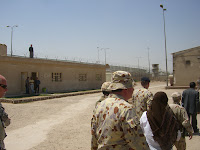

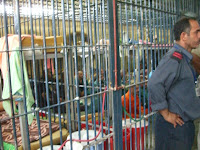

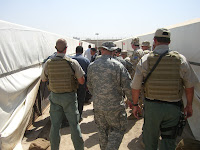
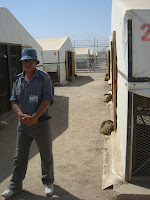
After being greeted by LAOTF's director, Mike Walther, the Minister first toured the detainee holding cells (see pictures above). Both the indoor and outdoor facilities meet humane international standards regarding space allotment, hygiene, etc. The indoor facilities hold 15 detainees to a cell, and all the detainees we spoke with raved at being there rather than other places from which they'd been transferred (including the infamous Abu Ghraib). The outdoor facilities -- large, air conditioned, tented cages -- similarly meet world standards, even if the set-up seems strange at first.
This was my second time at the ROLC, and I have yet to hear a detainee complain about the Rusafa facilities or the treatment they receive there. (For example, the complex receives 2000 male visitors and 500 female per week, and there are two doctors and five nurses on staff.) The Rusafa detention complex currently houses 5600 detainees, and is being expanded to a maximum capacity of over 7000. The hope, however, is that the number of detainees will go down and/or keep changing as people are moved through the system (more on this issue later).
Both the LAOTF Director and the Minister spent a considerable amount of time talking with the detainees, taking note of claims that certain folks were being held for no reason, or had been in detention in various places for 2-3 years without a hearing. "Nobody in prison is ever guilty," of course, but we know that a not insignificant number of detainees are held in pre-trial detention longer than the maximum sentence for their crimes, while others just got caught in a sweep at the wrong place at the wrong time.
The problem is a lack of records on so many people (80%). They've even resorted at times to asking the detainees themselves whether they know what they're in for as a preliminary record. There are just not enough capable judicial investigators (JIs), and even if there were, the police investigators (PIs) just have not done a thorough enough job of documenting arrestees. Eventually, insufficient evidence will get detainees released even when the security forces who detained them have no doubts of their guilt. The message to the Iraqi police is: if you don't want to see the most dangerous criminals back on the street in short order, you better be very thorough in the collection of evidence, and in maintaining records about the suspects you arrest. But they aren't, and so many of the most dangerous end up right back on the street to sabotage and kill again. The flipside, again, is that innocents or those picked up for light offenses languish in detention while their "no records available" files are investigated.
The Minister requested an office at the complex to monitor detainee issues, and was instantly given approval by the LAOTF chief of staff, a retired military officer and judge.
After the tour of the detention facilities, we made our way to the court and then to the office of the chief trial (as opposed to investigative) judge there. The Minister had a spirited discussion with the judge. First over jurisdiction. There is an institutional dispute over whether the ROLC would deal with only detainees from Rusafa, rather than the estimated 80% who have been brought from overcrowded jails elsewhere in Baghdad and even surrounding provinces. Just that morning, however, an agreement was reached that all detainees at the Rusafa complex would be under the Rusafa court's jurisdiction, wherever their original (and usually undocumented) provenance. The Minister insisted that more detainees be processed and either released or tried/sentenced, with the judge promising to do his best given the institutional/manpower limitations. She also asked to watch some of the trials -- which invitation was again instantly extended by the Chief of Staff.
At this point, our work being done, we were escorted back to the helipad by our very professional security detail (the guy in charge of my SUV was a South African, clearly former special forces of some kind), and made the short flight back to the IZ. (See pictures below.)
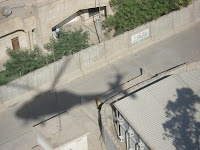

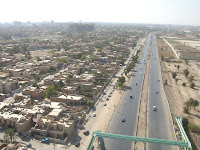
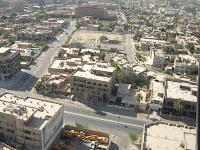
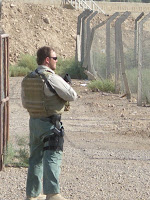
The trip across the river only takes a few minutes, and so within no time we were touching down beside the "Olympic Stadium" that Saddam had built before the Gulf War in a deluded attempt to bring the Olympics to Baghdad. It would become one of his son Uday's favorite torture grounds. And now it's next to the Baghdad Police College and the jail and court complex we had built.
All elements of the rule of law complex are directly responsible to the chief judge of the CCCI (the court I visited yesterday), the Ministry of Interior, and the Ministry of Justice. The Iraqi government -- by hiring a sophisticated international contractor -- is providing all security for the complex, and is fully funding it from the state budget. The Ministry of Interior is surging every available investigator there, as the Maliki government, rejecting a proposal to establish martial law, instead called upon the CCCI to sit in emergency session to process the ballooning population of security detainees. There are plans to expand the number of judges, and of course plans are in the works to open similar compounds in Ramadi and Baquba (capital of Diyala province).
After being greeted by LAOTF's director, Mike Walther, the Minister first toured the detainee holding cells (see pictures above). Both the indoor and outdoor facilities meet humane international standards regarding space allotment, hygiene, etc. The indoor facilities hold 15 detainees to a cell, and all the detainees we spoke with raved at being there rather than other places from which they'd been transferred (including the infamous Abu Ghraib). The outdoor facilities -- large, air conditioned, tented cages -- similarly meet world standards, even if the set-up seems strange at first.
This was my second time at the ROLC, and I have yet to hear a detainee complain about the Rusafa facilities or the treatment they receive there. (For example, the complex receives 2000 male visitors and 500 female per week, and there are two doctors and five nurses on staff.) The Rusafa detention complex currently houses 5600 detainees, and is being expanded to a maximum capacity of over 7000. The hope, however, is that the number of detainees will go down and/or keep changing as people are moved through the system (more on this issue later).
Both the LAOTF Director and the Minister spent a considerable amount of time talking with the detainees, taking note of claims that certain folks were being held for no reason, or had been in detention in various places for 2-3 years without a hearing. "Nobody in prison is ever guilty," of course, but we know that a not insignificant number of detainees are held in pre-trial detention longer than the maximum sentence for their crimes, while others just got caught in a sweep at the wrong place at the wrong time.
The problem is a lack of records on so many people (80%). They've even resorted at times to asking the detainees themselves whether they know what they're in for as a preliminary record. There are just not enough capable judicial investigators (JIs), and even if there were, the police investigators (PIs) just have not done a thorough enough job of documenting arrestees. Eventually, insufficient evidence will get detainees released even when the security forces who detained them have no doubts of their guilt. The message to the Iraqi police is: if you don't want to see the most dangerous criminals back on the street in short order, you better be very thorough in the collection of evidence, and in maintaining records about the suspects you arrest. But they aren't, and so many of the most dangerous end up right back on the street to sabotage and kill again. The flipside, again, is that innocents or those picked up for light offenses languish in detention while their "no records available" files are investigated.
The Minister requested an office at the complex to monitor detainee issues, and was instantly given approval by the LAOTF chief of staff, a retired military officer and judge.
After the tour of the detention facilities, we made our way to the court and then to the office of the chief trial (as opposed to investigative) judge there. The Minister had a spirited discussion with the judge. First over jurisdiction. There is an institutional dispute over whether the ROLC would deal with only detainees from Rusafa, rather than the estimated 80% who have been brought from overcrowded jails elsewhere in Baghdad and even surrounding provinces. Just that morning, however, an agreement was reached that all detainees at the Rusafa complex would be under the Rusafa court's jurisdiction, wherever their original (and usually undocumented) provenance. The Minister insisted that more detainees be processed and either released or tried/sentenced, with the judge promising to do his best given the institutional/manpower limitations. She also asked to watch some of the trials -- which invitation was again instantly extended by the Chief of Staff.
At this point, our work being done, we were escorted back to the helipad by our very professional security detail (the guy in charge of my SUV was a South African, clearly former special forces of some kind), and made the short flight back to the IZ. (See pictures below.)
Tuesday, August 14, 2007
Goin' to Court
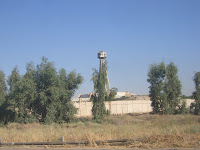
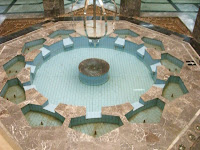
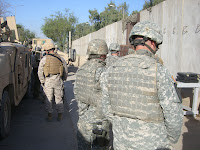
Today, for the third straight day, I donned my body armor and deployed beyond "the wire" -- into the "Red" Zone. This time it was by SUV instead of helicopter, in a convoy of military lawyers headed to the Central Criminal Court of Iraq (CCCI). On the way we got a great view of the crossed-swords monument (each hand modeled after Saddam's) before we approached the "clock tower" coming out of another flying-saucer-type building. When we got there we waited outside a barrier for a bit, then walked a 100m "gauntlet" of open space that could, in theory, be perfect for an ambush.
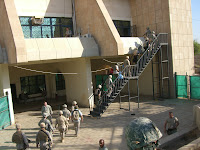
Every day, a group of young JAGs, most of them younger than me, make this trek, and assume their "battle stations" within the court (which used to be the Museum of Saddam. There they present to the Investigating Judge (IJ) the evidence they have collected relating to detentions made by coalition forces. That is the extent of the role they play; interviewing witnesses (mainly soldiers, writing memos to the judge, playing the role not of prosecutor, but judicial liaison).

Iraq has a civil (continental, as opposed to common, or English) legal system, which means the IJ directs an inquisitorial process, questioning witnesses, evaluating other evidence, and then summarizing it for presentment to a trial panel of three judges. The IJ literally dictates his summary/findings to a scribe, who, by hand, takes it down, making copies with carbon paper. (One of the first dilemmas of the rule of law project here was finding carbon paper for the Iraqis to use because, of course, we haven't used it in years in the US.)
The investigative hearing I observed involved a weapons charge; a platoon of soldiers arrested a guy after they found a mortar launcher in his home, which home he acknowledged had been provided him by the JAM (the al-Mahdi militia). The judge took testimony of two soldiers, partially in English, partially with the aid of an interpreter, and then questioned the detainee. The JAG asked about one question per witness and the defense attorney opened her mouth but one time during the entire proceeding, and that was to ask one of the soldiers how he knew the mortar launcher was in good condition. "Because I'm a mortarman," the soldier replied with a grin. There's no way an American defense counsel would've asked that question.
The hearing took about an hour and a half, in what you could call an office (we sat on couches, the counsel and witnesses on chairs), and was interrupted a series of times by well-wishers and clerks of all sorts. Not so much chaotic -- the judge had things under control -- but bizarre. After it was over, the JAG told us that, if convicted, the detainee faced probably 10 years in prison. The detainee's sole argument is that the mortar was not his and he had no involvement with it -- even though he was living with it and knew it belonged to the JAM (itself a crime of sorts).
Then I went to the adjoining hall to witness a trial. Eight men in yellow jumpsuits were in the dock (literally, a wooden holding pen), as the chief judge read a summary of the evidence and briefly questioned several of the accused. Then the "prosecutor" (more a magistrate whose role is to make legal recommendations to the judges rather than urge conviction) had a chance to speak, and then the defense counsel. The men had been charged with a rather brutal kidnapping, as well as firing at coalition forces in a failed escape attempt. Interestingly, no evidence of the kidnapee (dead, alive, safe, or otherwise) had been presented. The proceedings took about 20 minutes, then judges deliberated for about 5 minutes.
Guilty! the chief judge pronounced, and sentenced each of the prisoners to life in jail. (We learned all these details after the court adjourned because there was no simultaneous translation.) The criminals did not react in the slightest, though I'm told that some of them kiss the ground and begin praying when acquitted. Note that neither the JAGs nor any other American/coalition forces played any role in the trial.
All in all, a fascinating morning.
Every day, a group of young JAGs, most of them younger than me, make this trek, and assume their "battle stations" within the court (which used to be the Museum of Saddam. There they present to the Investigating Judge (IJ) the evidence they have collected relating to detentions made by coalition forces. That is the extent of the role they play; interviewing witnesses (mainly soldiers, writing memos to the judge, playing the role not of prosecutor, but judicial liaison).
Iraq has a civil (continental, as opposed to common, or English) legal system, which means the IJ directs an inquisitorial process, questioning witnesses, evaluating other evidence, and then summarizing it for presentment to a trial panel of three judges. The IJ literally dictates his summary/findings to a scribe, who, by hand, takes it down, making copies with carbon paper. (One of the first dilemmas of the rule of law project here was finding carbon paper for the Iraqis to use because, of course, we haven't used it in years in the US.)
The investigative hearing I observed involved a weapons charge; a platoon of soldiers arrested a guy after they found a mortar launcher in his home, which home he acknowledged had been provided him by the JAM (the al-Mahdi militia). The judge took testimony of two soldiers, partially in English, partially with the aid of an interpreter, and then questioned the detainee. The JAG asked about one question per witness and the defense attorney opened her mouth but one time during the entire proceeding, and that was to ask one of the soldiers how he knew the mortar launcher was in good condition. "Because I'm a mortarman," the soldier replied with a grin. There's no way an American defense counsel would've asked that question.
The hearing took about an hour and a half, in what you could call an office (we sat on couches, the counsel and witnesses on chairs), and was interrupted a series of times by well-wishers and clerks of all sorts. Not so much chaotic -- the judge had things under control -- but bizarre. After it was over, the JAG told us that, if convicted, the detainee faced probably 10 years in prison. The detainee's sole argument is that the mortar was not his and he had no involvement with it -- even though he was living with it and knew it belonged to the JAM (itself a crime of sorts).
Then I went to the adjoining hall to witness a trial. Eight men in yellow jumpsuits were in the dock (literally, a wooden holding pen), as the chief judge read a summary of the evidence and briefly questioned several of the accused. Then the "prosecutor" (more a magistrate whose role is to make legal recommendations to the judges rather than urge conviction) had a chance to speak, and then the defense counsel. The men had been charged with a rather brutal kidnapping, as well as firing at coalition forces in a failed escape attempt. Interestingly, no evidence of the kidnapee (dead, alive, safe, or otherwise) had been presented. The proceedings took about 20 minutes, then judges deliberated for about 5 minutes.
Guilty! the chief judge pronounced, and sentenced each of the prisoners to life in jail. (We learned all these details after the court adjourned because there was no simultaneous translation.) The criminals did not react in the slightest, though I'm told that some of them kiss the ground and begin praying when acquitted. Note that neither the JAGs nor any other American/coalition forces played any role in the trial.
All in all, a fascinating morning.
TCS Column: Is Rule of Law Possible in Iraq?
Here is a link to my latest Dispatches from Purple America column.
Monday, August 13, 2007
My Hooch
Each picture I put up is worth roughly 1000 words, they tell me, so instead of describing where I live, here's the photographic evidence. (Note that I can't show anything of the outside of the trailer other than the front door because that would give away how our security works.)


Busy Day in Ramadi
My good friend Mario Loyola has a multi-media presentation from Ambassador Crocker's important visit to Ramadi the same day I was there.
A Day in Anbar, Part II
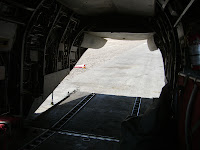
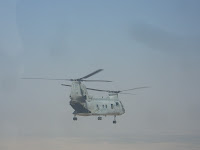
After the briefing in Fallujah, we boarded Marine Chinooks (larger helicopters with two horizontal rotating blades) and took off for Ramadi. Ramadi is the provincial capital, and was the scene of some of the fiercest fighting in Iraq until a few months ago, and now coalition forces can walk around without body armor.

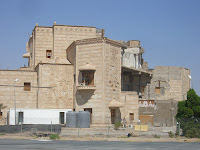
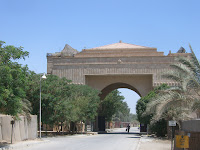
 We landed at Camp Blue Diamond, between the cleverly named JDAM Palace (a JDAM is a very heavy bomb, and this particular palace was partially destroyed by one) and another grand palace that Saddam for some reason constructed without putting in any plumbing. The JDAM is currently an Iraqi Army (IA) facility, while the head-less wonder (get it?) holds the offices of the commander of the Iraqi 7th Infantry Division.
 There we split into two groups: one for the decision-makers who went off to tour the city's government center, to meet with the governor and chief provincial judge and examine the site of the "temporary" rule of law facility where judges would begin work while the plumbing-less palace was retrofitted into a courthouse; and the other, mine, to meet the "mayor" of Blue Diamond (a first sergeant) and go over the logistics of moving IA and coalition facilities and constructing/renovating new ones for the rule of law complex.
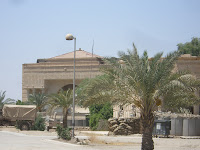
 Then we had lunch at the base DFAC -- smaller and sparser than our opulent embassy facility, to be sure, but still some mighty fine chow -- whose plywood interior eating area was positively festooned with flags representing all the teams in the NFL, NBA, MLB, and NHL (because there are lots of soldiers from Edmonton here, so wouldn't want to leave the Oilers out). Just to make it feel like home -- assuming your home was a combination ESPN Zone and boy scout camp.
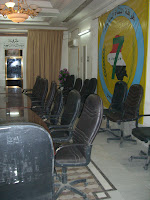
 Finally we got a tour of all the assorted palaces, villas, and other buildings that would make up the rule of law compound, and headed back to the facility-lacking facility to check out the general's quarters and have a "hot wash" meeting, gauging everyone's impressions of and ideas for the project. I can't really reveal any more about this deal because it's sensitive politically (as opposed to for security reasons, for once), but there was a mood of cautious optimism. This can be done.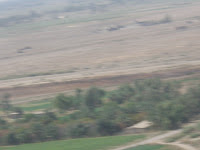


 Finally we boarded our Chinooks and headed for home, again over the austere, desolate land we've come to know and broil in.
We landed at Camp Blue Diamond, between the cleverly named JDAM Palace (a JDAM is a very heavy bomb, and this particular palace was partially destroyed by one) and another grand palace that Saddam for some reason constructed without putting in any plumbing. The JDAM is currently an Iraqi Army (IA) facility, while the head-less wonder (get it?) holds the offices of the commander of the Iraqi 7th Infantry Division. There we split into two groups: one for the decision-makers who went off to tour the city's government center, to meet with the governor and chief provincial judge and examine the site of the "temporary" rule of law facility where judges would begin work while the plumbing-less palace was retrofitted into a courthouse; and the other, mine, to meet the "mayor" of Blue Diamond (a first sergeant) and go over the logistics of moving IA and coalition facilities and constructing/renovating new ones for the rule of law complex.Here I should explain that the plans for the Ramadi Rule of Law Complex are much less ambitious than the existing Rusafa Complex, both because Anbar is much smaller than Baghdad (just 1.something million) and because it's all Sunni, so security needs are much smaller.
Then we had lunch at the base DFAC -- smaller and sparser than our opulent embassy facility, to be sure, but still some mighty fine chow -- whose plywood interior eating area was positively festooned with flags representing all the teams in the NFL, NBA, MLB, and NHL (because there are lots of soldiers from Edmonton here, so wouldn't want to leave the Oilers out). Just to make it feel like home -- assuming your home was a combination ESPN Zone and boy scout camp.Finally we got a tour of all the assorted palaces, villas, and other buildings that would make up the rule of law compound, and headed back to the facility-lacking facility to check out the general's quarters and have a "hot wash" meeting, gauging everyone's impressions of and ideas for the project. I can't really reveal any more about this deal because it's sensitive politically (as opposed to for security reasons, for once), but there was a mood of cautious optimism. This can be done.Finally we boarded our Chinooks and headed for home, again over the austere, desolate land we've come to know and broil in.
Subscribe to:
Posts (Atom)

 Posts
Posts

